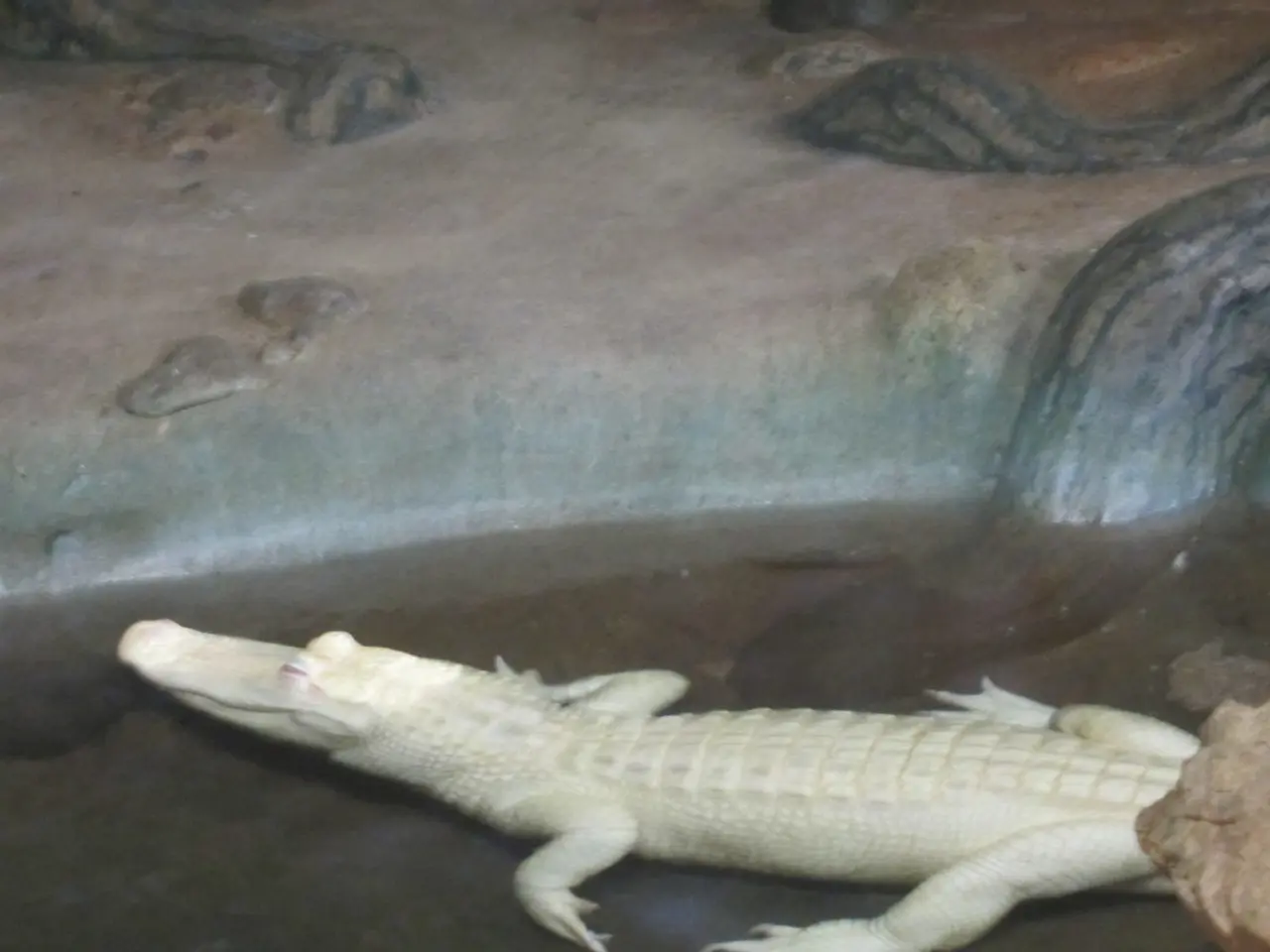
Evolutionary Changes in Crocodiles: Previously believed to be unchanged for thousands of years, Frans Lanting's research suggests that crocodiles have undergone more evolutionary shifts than previously assumed.
News Article: Uncovering the Evolutionary History of Crocodylomorphs
A new study published in Royal Society Open Science delves into the evolutionary history of crocodylomorphs, a diverse group of archosaurs that have an evolutionary history extending back about 245 million years. The study aimed to investigate whether modern crocodile capabilities are ancient holdovers or recent specializations from their long evolutionary history.
The researchers created virtual models of five extinct crocodiles to compare their trunk flexibility with a model of a Nile crocodile spine. The findings revealed some unexpected differences in the spine flexibility of extinct crocodiles compared to expectations based on their lifestyle.
For instance, terrestrial crocodylomorphs like Terrestrisuchus and Protosuchus were small, land-dwelling predators. Contrary to predictions, these early, land-dwelling crocs were found to have more flexible spines up-and-down than from side-to-side. In contrast, marine species like Steneosaurus and Metriorhychus, prehistoric marine crocodiles, had spines that were stiffer from side-to-side due to their tail's propulsive work.
Terrestrisuchus had a spine that was more flexible from side-to-side than in the vertical plane and had a set of osteoderms that made it stiffer along the axis. This suggests that the process of increasing flexibility in the spine occurred in amphibious forms of prehistoric crocodiles, followed by greater trunk stiffness among full-time swimmers.
The study also shed light on the evolution of marine crocodylomorphs. The thalattosuchian crocs transitioned from nearshore life to open ocean life millions of years before the first whales. Marine species like Metriorhychus were semi-aquatic and had paddle-shaped limbs and fluke-tipped tails, well-adapted for swimming in open waters.
The study used trunk-bending experiments on a carcass from the living Nile crocodile species to verify the model of its spine. The results indicate that modern crocodiles are specialized creatures and are a sliver of what once existed in the Mesozoic.
The study by Molnar and coauthors suggests that if today's crocodylians survive, some might reprise the roles their predecessors took on land and in the seas. With such a rich and diverse evolutionary history, crocodylomorphs continue to captivate paleontologists and offer valuable insights into the adaptive strategies of ancient creatures.
References:
[1] Benton, M. J. (2005). Vertebrate Paleontology. Blackwell Publishing.
[2] Carroll, R. L. (2006). Vertebrate Paleontology and Evolution. W.H. Freeman.
[3] Molnar, R. W., Pierce, S. E., Bhullar, P. S., Turner, A. H., & Hutchinson, J. R. (2015). Morphological and functional changes in the vertebral column with increasing aquatic adaptation in crocodylomorphs. Royal Society Open Science, 2(12), 150980.
[4] Turner, A. H., & Hutchinson, J. R. (2014). Dietary ecology and evolutionary adaptations in crocodylomorphs. In Crocodylomorphs: Extinct and Extant (pp. 23-42). Elsevier.
- The evolutionary history of crocodylomorphs, a group of archosaurs spanning 245 million years, has captivated the field of science, shedding light on the history, ecology, and adaptive strategies of ancient species.
- The study on the evolutionary history of crocodylomorphs reveals fascinating insights into the differences in spine flexibility among extinct species, as seen in terrestrial species like the Terrestrisuchus and marine species like Steneosaurus.
- In the realm of health-and-wellness and fitness-and-exercise, the study offers a deeper understanding of the functioning of modern crocodiles, emphasizing their status as specialized creatures that are a sliver of what once existed in the Mesozoic.
- The findings of this study also demonstrate the impact of lifestyle on the evolution of crocodiles, as terrestrial crocodylomorphs like Terrestrisuchus were found to have more flexible spines in the horizontal plane, while marine species like Metriorhychus had stiffer sides due to their tail's propulsive work.
- As sports analysts and mixed-martial-arts enthusiasts ponder the characteristics and adaptations of ancient predatory species, the evolutionary history of crocodylomorphs provides a wealth of knowledge, offering a glimpse into the capabilities and strategies of animals that once dominated the earth.