
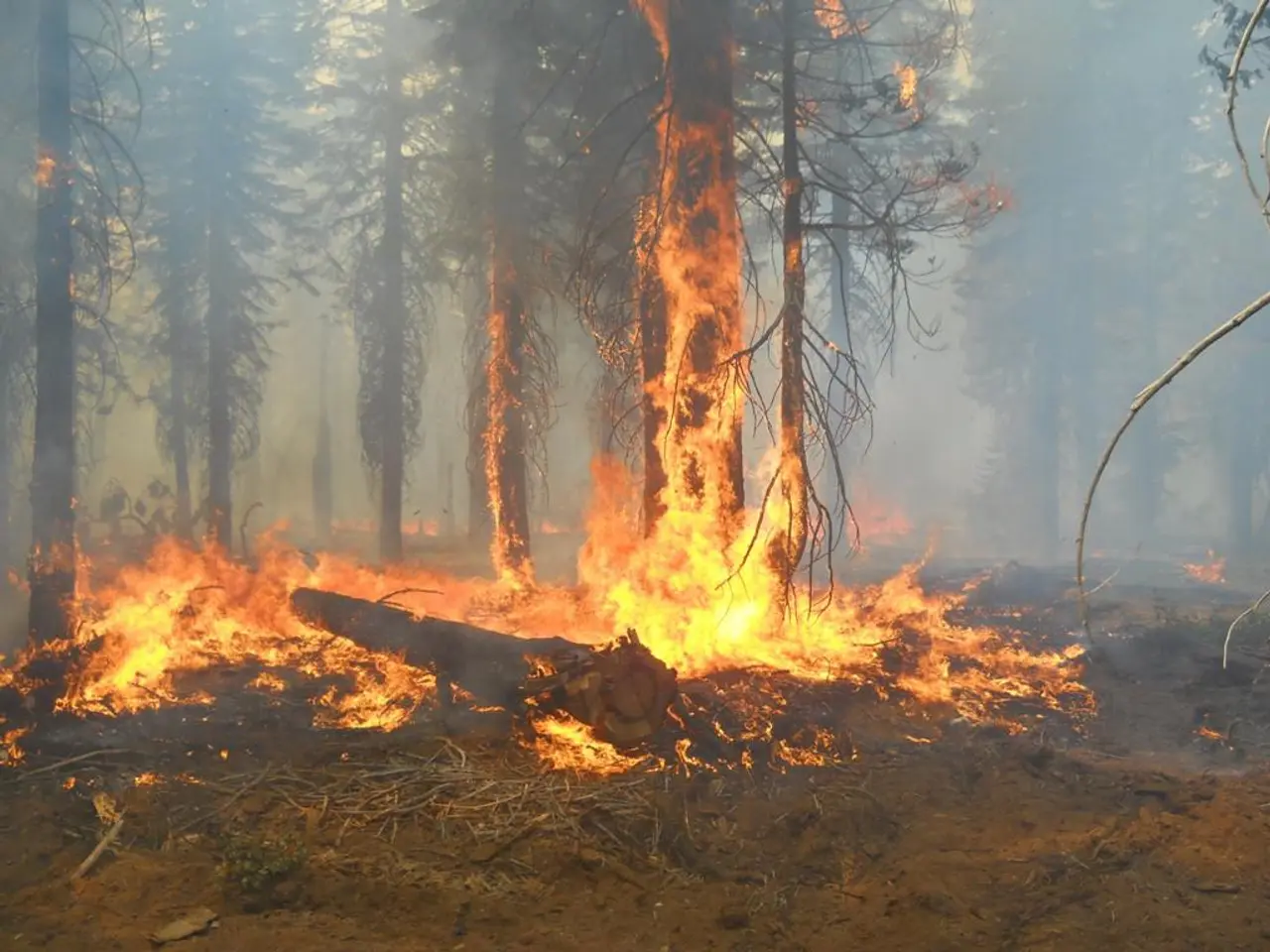
Southern region blazes: Europe and Turkey grapple with raging wildfires
In the heart of summer, the Mediterranean and Balkan regions are battling a relentless heatwave that has fueled a surge in wildfires, creating a critical fire risk environment.
The current weather forecast paints a grim picture, with soaring temperatures, low humidity, and dry conditions making it difficult to control even the smallest of fires, whether caused by negligence, arson, or lightning strikes.
Greece is on high alert due to expected strong winds in the coming days, as the forest fire risk remains extremely high in the south of Euboea, the east of Crete, and the region around Athens. Despite recent rain, the fire danger remains high in many parts of the country.
Turkey has been hit hard by wildfires, with more than 2,000 forest fires breaking out so far this year, according to the Ministry of Forestry and Environment. At least 14 people, including firefighters, have lost their lives in the fires. However, firefighters in Turkey have largely controlled the forest fires, as reported by the state news agency Anadolu.
Spain is not immune to the fire threat. The second major forest fire in Las Hurdes has been brought under control, but firefighters in Cuevas del Valle south of Ávila are still battling a forest fire that received some help from rain, almost completely extinguishing it.
Isolated fires have been reported in the rural regions of Thrace and Izmir in Greece, and Sardinia in Italy. However, these were quickly extinguished by the firefighting teams.
The situation remains tense in Italy, particularly in the south, with the island of Sicily being particularly affected. More than 3,700 fires were registered between May and late July in Sicily, according to the local forestry authority. Firefighters in northern Portugal, near Ponte da Barca, are still struggling to contain the fires despite making significant progress.
The heatwave in southern Europe is not just causing fires but also disrupting outdoor, agricultural, and labor activities while significantly impacting public health. For instance, Portugal's head of civil protection, Elisio Oliveira, has stated that the weather conditions are unfavorable, with a new heatwave and temperatures over 40 degrees Celsius expected.
The environmental department of the regional government of Castile and León described the recent rain as "manna from heaven," but the respite is likely to be short-lived as the heatwave persists. The extreme heat and dry conditions are expected to maintain a critical environment promoting the ignition and rapid spread of ongoing forest fires across Portugal, Spain, Turkey, Greece, and Italy.
As firefighting resources remain engaged in unprecedented challenges under these extreme weather conditions, the consequences for ecosystems, human health, and local economies could be severe. The forecasted impacts include continued wildfire outbreaks, forced evacuations, health hazards from smoke and heat stress, disrupted tourism and agriculture, and heightened secondary risks such as soil erosion and flood potential following burnt areas.
[1] European Forest Fire Information System (EFFIS) - www.effis.eu [2] European Union's Copernicus Atmosphere Monitoring Service - www.atmosphere.copernicus.eu [3] World Health Organization - www.who.int [4] European Centre for Medium-Range Weather Forecasts (ECMWF) - www.ecmwf.int [5] European Commission - ec.europa.eu
- The escalating wildfires in Mediterranean and Balkan regions, largely attributed to the ongoing heatwave, have brought the importance of scientific study in health-and-wellness, environmental-science, and space-and-astronomy to the forefront.
- To combat the critical fire environment, there's a dire need for advancements in fitness-and-exercise, as firefighters and emergency responders must stay in peak physical condition to combat the increasingly intense fires and harsh weather conditions.
- The devastating impact of wildfires on ecosystems, public health, and local economies underscores the significance of climate-change research, as it can aid in anticipating and mitigating similar disasters in the future.